What Is Climbing Like When You Mountain Bike in Colombia?
Climbing varies a lot by ride, but the honest headline is this: expect climbing to be a normal part of mountain biking in Colombia, rather than something an uplift removes from your day. Some MBC rides are gentle and rolling. Others involve sustained climbing, high elevation, or several mountain days in a row. Two things are worth knowing before you come. Climbing fitness and technical skill are separate abilities, so a climb can be physically hard without being technical. And on several of MBC’s mountain itineraries, altitude can make an effort that felt easy at sea level feel much harder.
This page is about what the climbing here actually feels like, so you can choose a ride that matches what you want.
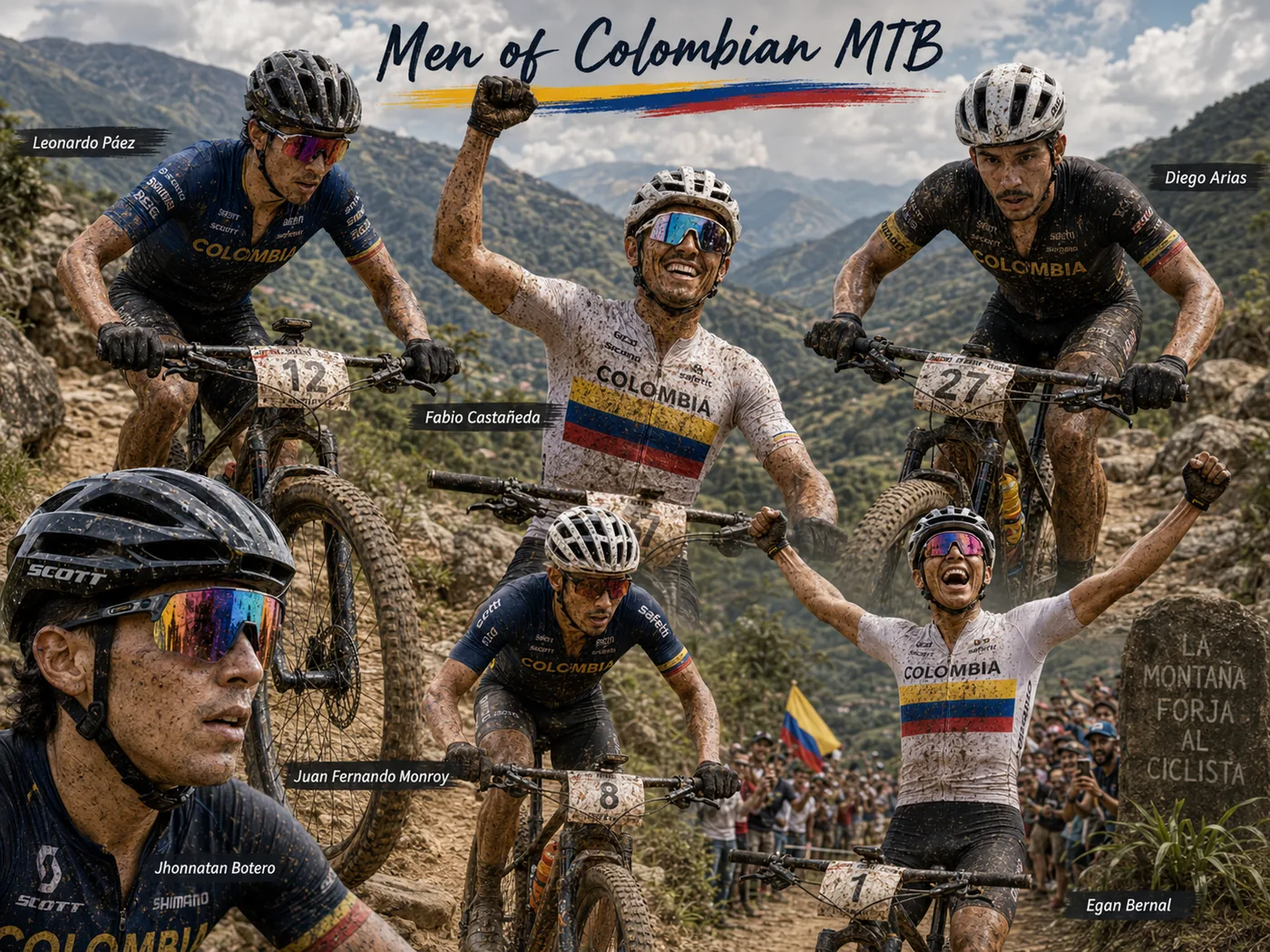
AI-generated editorial montage celebrating Colombian men’s mountain-bike and climbing culture. Illustration, not documentary photography.
In Colombia, the climb is part of the ride
For a lot of mountain bikers arriving in Colombia, the first real difference is not the trail surface, the altitude or the scenery. It is the attitude toward going uphill.
Colombians climb. Not because anyone is tougher by birth, but because the country’s geography and cycling culture have produced generations of riders for whom climbing is simply part of riding. When the mountains are that big and that constant, going up is not an obstacle you resent on the way to the fun part. It is the fun part, or at least half of it.
So the frame we would offer an experienced visitor is this: in Colombia, the climb is not simply the price you pay to reach the descent. The climb is part of the ride. Sometimes the hill is the ride.
At Mountain Bike Colombia, there is a question we tend to hear somewhere on a long climbing day:
Are there more climbs?
Yes. It’s just a hill. Get over it.
Why Colombia produces climbers
The geography does most of the work. Three ranges of the Andes run the length of the country, so many mountain rides in Colombia involve substantial climbing and descending, often repeatedly. On top of that, Colombia has an enormous network of rural roads, a vast web of unpaved gravel and earth roads threading up through mountainous country. Those are motor roads, not mountain-bike trails, but they mean the everyday riding environment here is full of real, unsealed climbing that ordinary riders do as a matter of course.
The results show up at the top of the sport. Luis “Lucho” Herrera became the first Colombian to win a Tour de France stage, at Alpe d’Huez in 1984, and went on to win the 1987 Vuelta a España, the first South American to win a Grand Tour. A generation later Nairo Quintana won the Giro d’Italia in 2014 and the Vuelta a España in 2016, and finished runner-up at the Tour de France in 2013 and 2015. And the rider who ties this most directly to mountain biking is Egan Bernal: he came up through competitive mountain biking, taking silver at the 2014 Junior Mountain Bike World Championships and bronze in junior cross-country in 2015 before moving to the road. In 2019 he became the first Colombian to win the Tour de France, and in 2021 he won the Giro d’Italia. Bernal was not a road climber who happened to own a mountain bike. He came through the dirt.
Colombia’s climbing pedigree is off-road too. Leonardo Páez has been a UCI Mountain Bike Marathon World Champion, in 2019 and 2020, on exactly the kind of long, climbing-heavy off-road terrain this country produces in abundance.
None of this means every Colombian rider is a great climber, any more than every American rider hits jumps. It means that here, climbing is woven into how people ride.
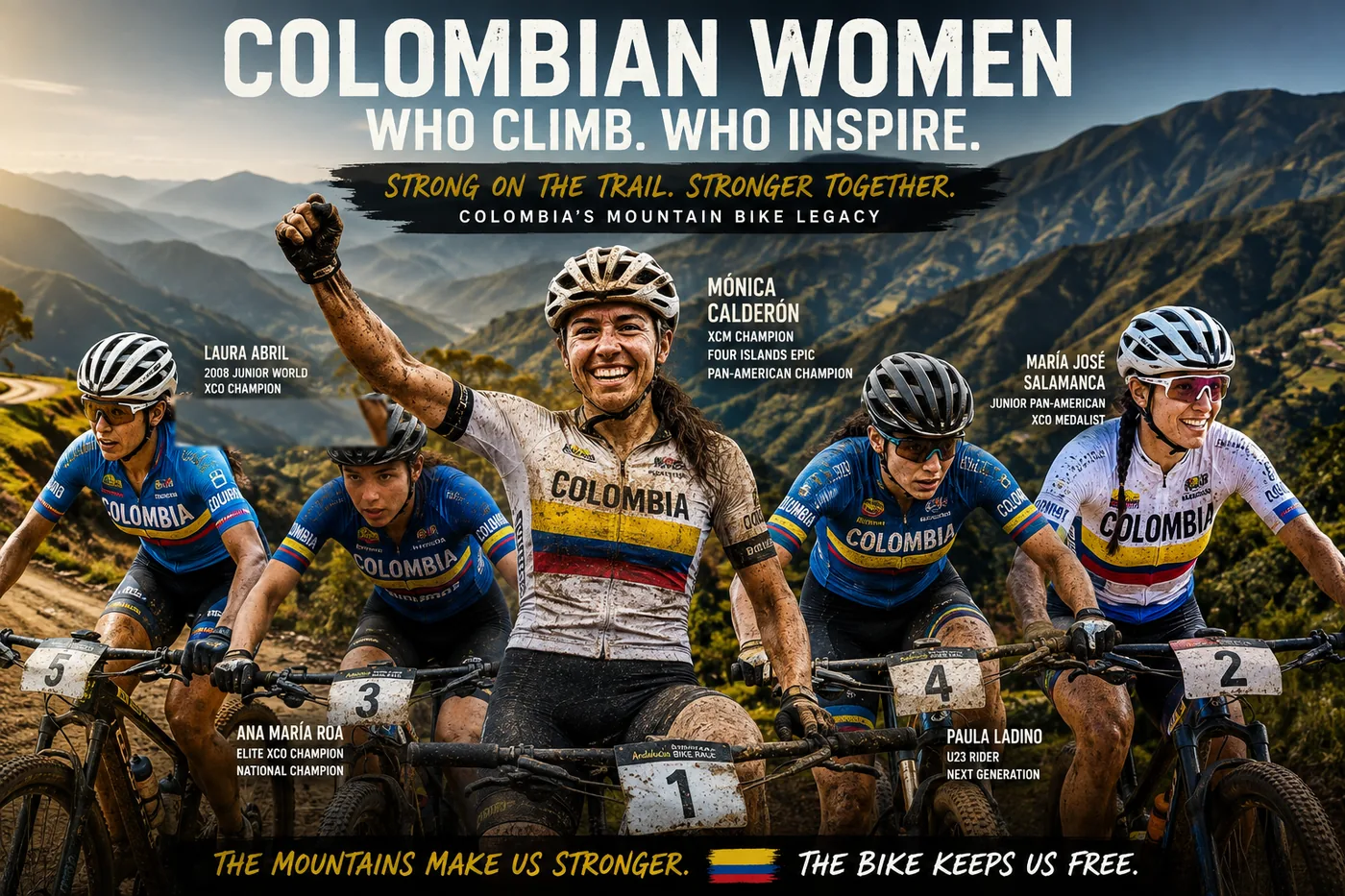
AI-generated editorial montage celebrating Colombian women in mountain biking. Illustration, not documentary photography.
The women who climb
Colombia’s reputation for producing climbers is not only a story about its famous male road racers. The country’s mountain-bike history has women in it from early on.
In 2008, at the UCI Mountain Bike World Championships in Val di Sole, Italy, an eighteen-year-old Colombian, Laura Abril, won the junior women’s cross-country title. It stands as one of Colombia’s earliest mountain-bike world titles. She went on to represent Colombia in cross-country at the 2012 London Olympics and to take continental titles later in her career.
A generation on, the clearest example of Colombian women and hard climbing is Mónica Calderón, from Támesis in Antioquia, who came to mountain biking from athletics and built a career in marathon and multi-day stage racing, among the sport’s most endurance- and climbing-intensive disciplines. She is the 2023 Pan-American marathon champion, a title she won over 72 kilometres in her home country. In 2025 she finished twentieth in the elite women’s race at the UCI Marathon World Championships in Switzerland, the best Latin American finisher on the day, and she won the five-day Four Islands Epic in Croatia with her Dutch partner Tessa Kortekaas, roughly 260 kilometres and around 6,500 metres of climbing across the week, taking the prologue and every stage. Her own motto, in her words, is mud on the skin, fire in the soul.
The generation behind her is arriving. Ana María Roa is Colombia’s current elite cross-country national champion; Paula Ladino holds the under-23 national title; younger riders such as Daniela Gaviria and María Salamanca have been winning and medalling in junior cross-country at the Pan-American level. Colombian women are still lining up, still climbing, and still winning.
Not every one of them is a marathon climber, and we are not claiming Colombian women as a group out-climb anyone. The point is simpler: the climbing culture here has never belonged only to the men.
Never guess a Colombian rider’s climbing from the outside
A story from our own rides, offered as an anecdote and nothing more. More than once we have watched a strong Colombian woman sit quietly on a climb with a group of visiting male riders, wait, then lift the pace and ride away, with enough time at the top to take a victory selfie before the visitor arrives.
That does not mean Colombian women automatically out-climb visiting men, and we are not claiming it does. The lesson is smaller and more useful: never estimate a Colombian cyclist’s climbing ability from their gender, their age, their appearance or their bike. The person you least expect may be the one who rides away from you on the hill. Come ready to be surprised, and to enjoy it.
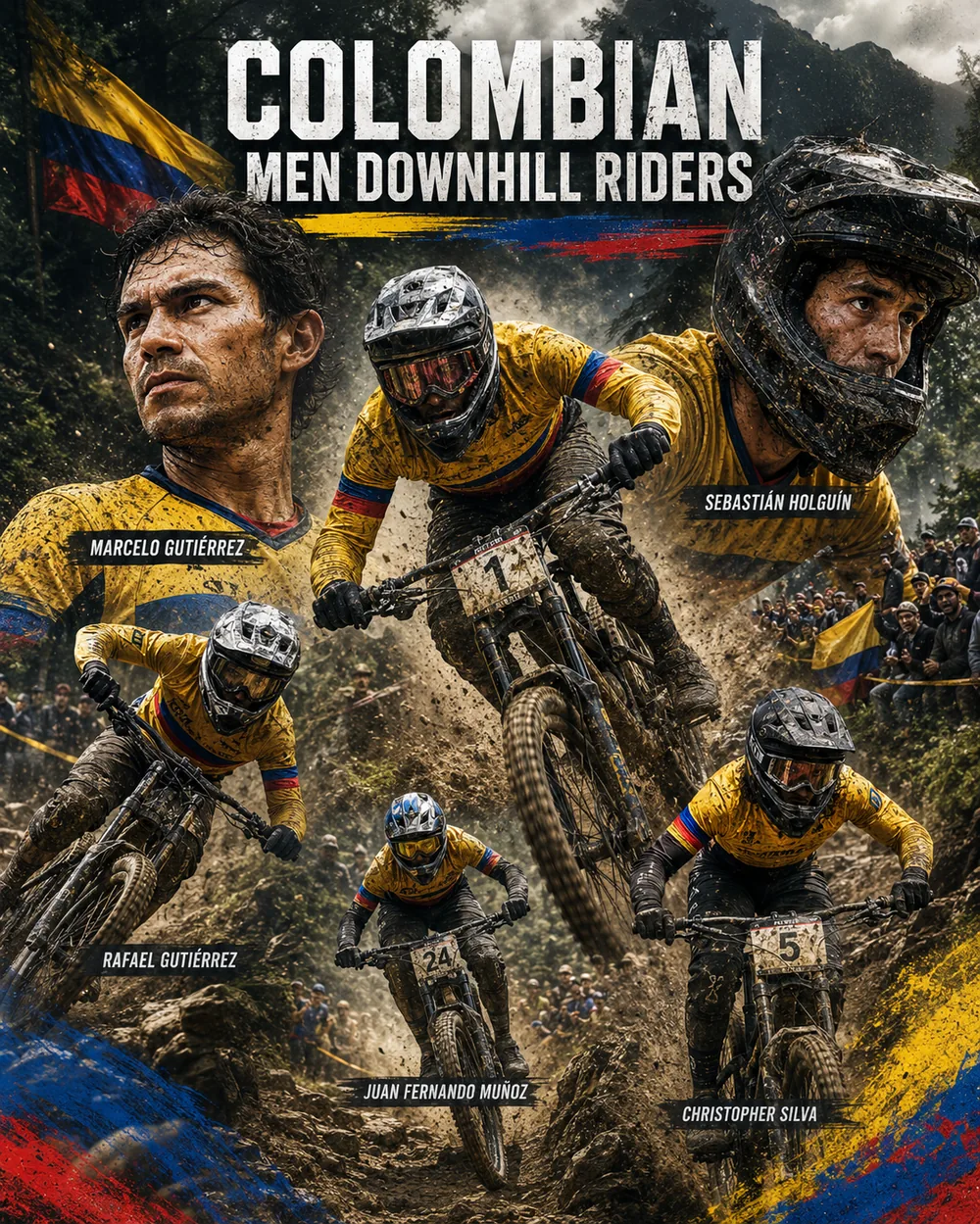
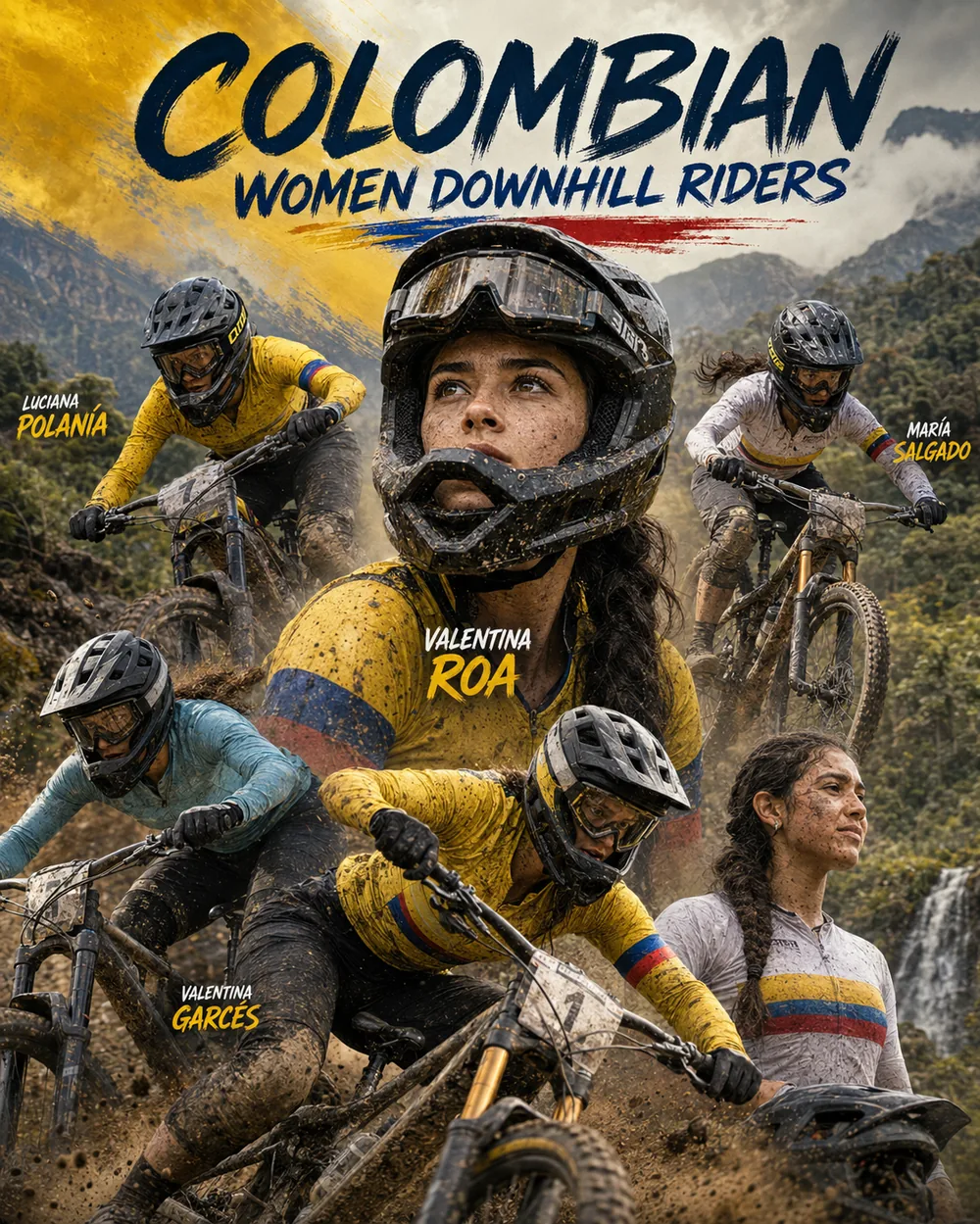
AI-generated editorial montages celebrating Colombian men’s and women’s downhill mountain-bike culture. Illustrations, not documentary photography.
And then we point the bike downhill
Colombia became famous internationally for cyclists who could climb mountains. But mountain-bike culture here does not stop at the summit. Colombia has also produced riders who compete internationally in downhill and gravity events, men and women, and fast, technical descending is another real part of the country’s mountain-bike identity. It is the other half of a simple idea: we know how to climb these mountains, and we know how to come back down them. On an MBC ride you earn your descents under your own power, but the descending is a reward Colombian riders take seriously. If the climbs are where the day is won, the way back down is where a lot of the fun lives.
Mountain-bike climbing is different from road climbing
If your picture of “Colombian climbing” is a smooth paved pass like the ones the pros race, mountain-bike climbing is a different animal. Off-road, the surface fights back. You climb on loose gravel, dirt, rock, roots, ruts, mud, farm roads and stream crossings, and the gradient changes constantly. That asks for more than aerobic power. It asks for traction management, balance, pacing and bike handling, and it means the effort of a climb is not captured by its gradient alone. A smooth dirt road climb can be quietly brutal. A short, rooty pitch can stop you dead.
The United States comparison
This is a difference in riding culture and infrastructure, not in ability, so it is worth stating fairly. The United States has world-class cross-country, marathon and endurance riders, plenty of them stronger climbers than most people they ride with. It also has a mature lift-served bike-park culture: chairlifts, gondolas and shuttles that carry riders and bikes to the top so they can lap descents run after run. That is a legitimate and popular way to ride, and it is genuinely fun.
It also means that in many US settings the infrastructure can take much of the climbing out of the day. Colombia is different, mostly because the geography and the way routes are put together make climbing hard to avoid. Neither is better. They are different relationships with going uphill, and it helps to know which one you are walking into.
Technical ability is not climbing fitness
This is the practical distinction most worth carrying into a booking. Technical ability and climbing fitness are separate things, and being good at one does not make you good at the other.
A rider can descend technical terrain beautifully and still struggle on a sustained climb. Another can climb all day and feel out of their depth pointing down something steep and loose. And the surface label tells you less than you think. Singletrack is not automatically hard. A dirt road is not automatically easy. A smooth dirt climb can be physically demanding for an hour or more, while a technical descent might involve very little climbing at all. When you weigh a ride, weigh the climbing demand and the technical demand as two separate questions.
How altitude changes the effort
Now the practical part that catches the most people out. Several of MBC’s mountain itineraries operate from around 1,800 metres up into terrain above 3,000 metres, especially in the Coffee Region and the Andes, and those higher expeditions spend real time up high. That matters because there is simply less oxygen available. Travel-medicine and sports-medicine sources describe a steady drop in aerobic performance as you climb above about 1,500 metres, which is why an effort that feels easy at sea level can feel noticeably harder here, and why you may tire sooner in the first day or two.
The point riders most often get wrong is that fitness protects you. According to public health guidance from the US Centers for Disease Control and Prevention, training and physical fitness do not affect your risk of altitude illness. Altitude affects people differently, from one person to the next and even from one trip to the next, and being a strong cyclist does not make you immune.
The general, non-medical guidance that travel-medicine sources give is simple and worth following: give yourself time to acclimatize rather than arriving and immediately going hard, ease into effort over the first day or two, pace your early climbs, and go easy on alcohol at first. If you develop a headache along with nausea, dizziness, unusual fatigue or poor sleep after arriving at altitude, treat it as a signal to stop climbing and rest, do not go higher with symptoms, and if they get worse, descend and get medical help. This page is general information, not medical advice. Altitude affects everyone differently, so follow current guidance from authoritative sources such as the US Centers for Disease Control and Prevention and the Wilderness Medical Society, and talk to your own doctor before a high-altitude trip, especially if you have any heart, lung or other medical condition.
Short and steep, long and sustained, or rolling
“How much climbing” is more useful once you break it into shapes, because the same amount of vertical can feel completely different:
- Short and steep. Punchy pitches that spike your heart rate, sometimes steep enough to walk. Over quickly, but they add up.
- Long and sustained. A single climb that goes on for a long time at a steadier grade. This is where pacing and gearing matter most, and where altitude bites hardest.
- Rolling and repeated. Constant up-and-down all day, no single big climb but no real rest either. Common on multi-day routes.
- Road versus trail climb. A climb on a rural or farm road is mostly an aerobic effort. A climb on trail adds traction and handling to the cost.
- High-altitude climb. Any of the above, made harder by thin air above roughly 2,500 metres.
What climbing looks like on actual MBC rides
MBC does not sell lift-served or repeated gravity-shuttle laps as its normal riding model, and the riding itself is generally pedalled. Where a vehicle or boat is used, it is for access, luggage, repositioning or extraction, not to carry you to the top of a descent. The climbing profile still varies a lot. A few real examples, not the full catalogue. To match a ride to your legs, use Find Your Ride.
- Guatapé Backcountry is the gentle end: rolling, not flat and not technical, with gentle climbs and short descents, from a base around 1,800 metres. Not every ride here is a mountain day.
- The Paisa route is a three-day journey through Antioquia, from Guatapé out through Alejandría, Santo Domingo, Cisneros, San Roque and San Rafael and back. The elevations along the way are moderate and the profile rolls rather than delivering one giant climb, but the demand is the repeated climbing of consecutive riding days.
- The Coffee Region is a sustained, higher-altitude expedition, with riding documented from about 2,000 up to 3,680 metres and genuine multi-day climbing through the coffee mountains. It is where altitude starts to matter.
- The Andes expedition is the clearest example of sustained, altitude-affected climbing: an altitude range of about 1,400 to 2,800 metres with páramo sections above that, an average of roughly 800 to 1,200 metres of climbing per day, and sustained climbs of 40 to 50 kilometres. Its own page is blunt that you will feel the altitude on the high days.
- The Amazon is the outlier that proves the point: it is a lowland expedition, so its demands are heat, humidity and remoteness rather than altitude. Not every hard ride in Colombia is a high one.
How to know whether you are ready
Climbing demand is one axis; your fitness and technical level is another. This page describes the climbing you will meet. To place your own fitness and skill honestly against the demands of each ride, use the fitness and skill levels guide, which is the page built for that question. For how the surfaces and ride styles vary, see what mountain biking in Colombia is actually like, and to plan around conditions and season, see the best time to mountain bike in Colombia.
When you are ready to match a ride to your climbing appetite, altitude tolerance and the kind of riding you want, use Find Your Ride. For the wider picture of riding here, start with mountain biking in Colombia.
This article is general information, not medical advice. Altitude affects everyone differently; consult the CDC and the Wilderness Medical Society and speak with your own doctor before riding at altitude. Riding profiles can change with conditions and over time; ride details are described on each ride’s page. Last reviewed: September 1, 2026.